Rome is full of masterpieces, but some details whisper stories that guidebooks rarely explain.
Inside the Basilica of San Pietro in Vincoli, Michelangelo’s Moses sits in silence—powerful, tense, almost alive. Visitors are often struck not only by his gaze or muscular body, but by one extraordinary detail: his beard.
Long, dramatic, and sculpted with unusual intensity, Moses’ beard has inspired one of Rome’s most fascinating art legends—one that links the statue directly to Pope Julius II, the man who commissioned it.
Is it just a myth? Or is there more hidden in marble than we expect?
Michelangelo’s Moses in Rome: Context and History
Michelangelo carved Moses between 1513 and 1515 as part of the monumental tomb of Pope Julius II. The original project was meant to be colossal, featuring more than 40 statues, but political conflicts and financial issues forced repeated changes.
What remains today is the emotional core of the entire project.
📍 Location: Basilica of San Pietro in Vincoli
🪨 Material: Carrara marble
🎨 Period: High Renaissance
Moses dominates the space with a sense of restrained power, as if caught between stillness and sudden movement.
The Beard of Moses: Symbolism Beyond Decoration
In Renaissance art, nothing is accidental—especially not a beard carved by Michelangelo.
The beard traditionally symbolized:
wisdom and authority
spiritual maturity
divine inspiration
But in Moses, the beard goes further. Its twisting strands mirror the emotional turmoil of the biblical moment: Moses descending from Mount Sinai, discovering the betrayal of his people.
Art historians note that the beard enhances the statue’s psychological tension, acting almost as a visual extension of Moses’ inner conflict.
The Roman Legend: Is Pope Julius II Hidden in the Beard ?
Here begins the story that most museums never tell.
According to a popular Roman legend, Michelangelo subtly shaped Moses’ beard to echo the profile of Pope Julius II.
Why this idea persists:
Julius II was famous for his thick, imposing beard
He ruled with authority, determination, and force—traits shared with Moses
Michelangelo had a famously complex relationship with the pope
Some believe the sculptor embedded Julius II’s image as:
a secret tribute
a symbolic fusion of prophet and pope
or a private artistic signature
There is no historical documentation proving this theory—but its persistence reveals how strongly viewers sense a human presence behind the marble.
Pope Julius II: Power, Image, and Artistic Control
Known as Il Papa Terribile, Pope Julius II was not a passive religious figure. He was a warrior pope, a strategist, and one of the most influential art patrons in history.
He commissioned:
Michelangelo’s Sistine Chapel ceiling
Raphael’s Vatican Rooms
the rebuilding of St. Peter’s Basilica
His beard became a political symbol of strength and resilience. In this context, the visual association between Julius II and Moses feels less accidental—and more symbolically plausible.
Horns and Beard: Two Details Often Misunderstood
Many visitors are surprised to see horns on Moses’ head.
They are not a mistake, but the result of a medieval mistranslation of the Bible, where the Hebrew word for radiance was translated into Latin as horns.
Together, the horns and beard give Moses a supernatural authority—half human, half divine—perfectly aligned with Michelangelo’s dramatic vision.
Why This Sculpture Still Feels So Powerful Today
Sigmund Freud once wrote an entire essay on Michelangelo’s Moses, analyzing the moment of emotional restraint captured in stone.
That tension is everywhere:
– in the clenched muscles
– in the intense gaze
– especially in the restless beard
Standing before the statue, many visitors feel watched—judged, even. Few sculptures in Rome create such an immediate emotional reaction.
Visiting Michelangelo’s Moses Today
📍 Basilica of San Pietro in Vincoli
🎟️ Free entrance (donation appreciated)
⏰ Best time: early morning or late afternoon
Despite being close to major landmarks, this church remains one of Rome’s most underrated stops—making Moses a true hidden gem for curious travelers
Conclusion: Legend or Imagination ?
Is Pope Julius II really hidden in the beard of Moses?
Probably not.
But Rome thrives on stories where art, power, and imagination overlap. And Michelangelo’s Moses—with its extraordinary beard—continues to invite us to look closer, question deeper, and embrace the mystery.
Sometimes, legends tell us as much as facts.
Why does Michelangelo’s Moses have horns ?
The horns are due to a Latin mistranslation of the Hebrew word for “radiance” or “rays of light.” Michelangelo depicted them as physical horns to show Moses’ divine encounter on Mount Sinai.
Where is Michelangelo’s Moses located in Rome ?
It is located inside the Basilica of San Pietro in Vincoli (St. Peter in Chains), a short walk from the Colosseum. Entrance is free.
Did Michelangelo really hit the statue with a hammer ?
While a small mark exists on the knee, the story is likely an 18th-century legend created to emphasize the statue’s incredible lifelike quality.
Start Planning Your Private Rome Experience Today
Discover Rome like never before with private tours led by local experts. Perfect for first-timers and repeat travelers alike.
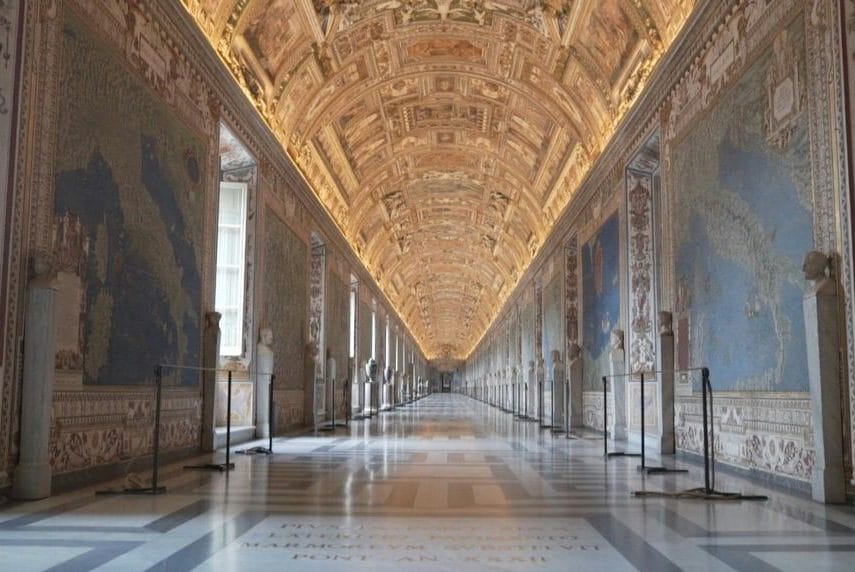
Vatican Museums and Sistine Chapel Tour
- What’s Included: Skip-the-line access, expert guide, Vatican Museums and Sistine Chapel.
- Duration: 3 hours
Explore the Vatican Museums and the Sistine Chapel with a 100% private guided tour, created exclusively for you and your group. Skip long lines, avoid crowded group tours, and enjoy one of the world’s most extraordinary art collections with a licensed expert guide.